
In 2010 a very exciting and promising breakthrough was announced to the scoliosis world. A company named Axial Biotech released the first genetic test for predicting if an adolescent idiopathic spinal curve (scoliosis in a teenager) would be likely to get worse.
The triumph was short lived as unfortunately 3 separate independent researchers were unable to reproduce the findings of the initial study of scoliosis in Caucasian US teens, published by Dr. Kenneth Ward, MD (chief scientific officer and a founder of Axial Biotech) and his associates in 2010.
These independent studies were unable to predict curve progression in Japanese, French Canadian or Han Chinese teens with scoliosis.
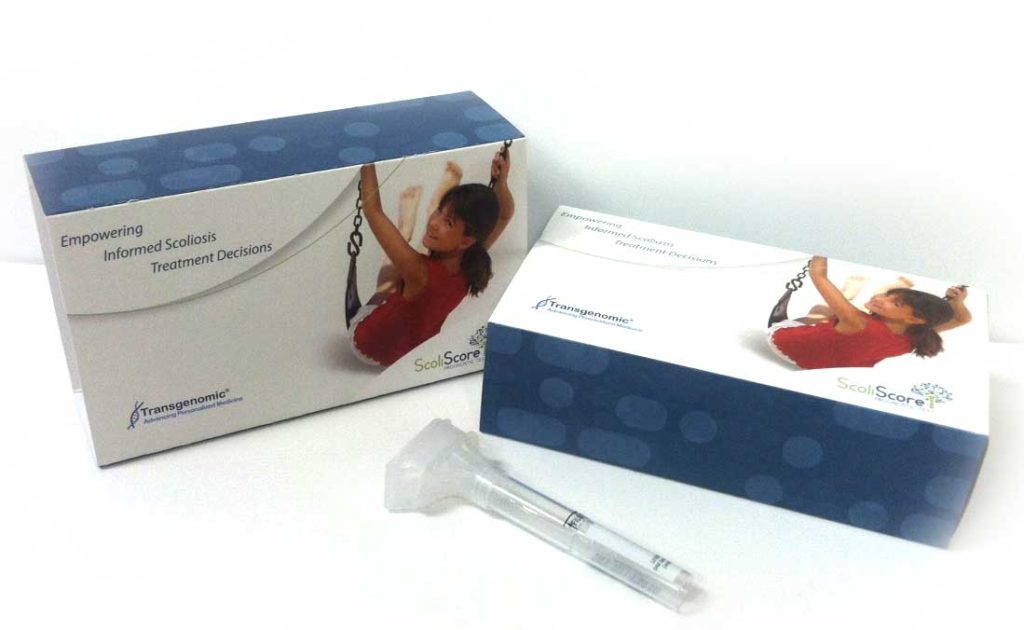
This failure to reproduce Ward’s results dampened the initial excitement, since the test could not be used in these other patient groups.
An independent review of the tests determined that ScoliScore could only predict curve progression in Caucasian females already diagnosed with scoliosis who were between the ages of 9 and 13 years. Further investigations into ScoliScore’s algorithm showed that the analysis relied heavily on the age of the patient and the size of their scoliosis curve at the time of the test!
Many scoliosis clinicians immediately cried “Foul”, and accused ScoliScore’s promoters of falsifying their claims of its predictive power. The children who received the test already had scoliosis AND Dr. Weinstein from the University of Iowa had already shown that the size of curve along with the age of the patient could be used as a formula to accurately predict curve progression!
It’s not that ScoliScore was wrong…. It was just that it only stated what was already known!
On this basis ScoliScore was never really a genetic test–although it certainly was marketed as one.
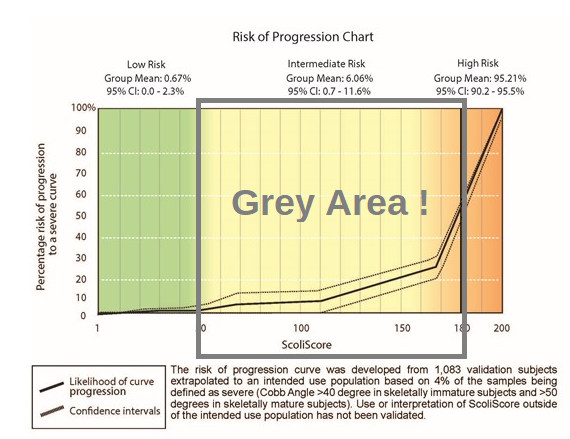
A further issue with ScoliScore was that many of the children tested had results that fell into a middle grey area of scoring… this middle score was useless for predictive power.
As scoliosis clinicians we look forward to the day when the complex hereditary pattern of AIS will be understood. At this time, clear gaps exist in understanding both scoliosis causes and the factors affecting its progression. A full understanding of either genetics or the underlying causes is unlikely to happen any time soon. Despite the huge number of people affected by scoliosis, the scoliosis research community is very small and the independent groups of scientists and clinicians doing the research have a wide variety of projects that do not align… advances in surgical techniques, surgical materials, brace designs, brace materials, best bracing candidates, specific exercise methodologies, genetic modeling, biological marker understanding, etc etc. are all different areas of scoliosis being researched.
The short term future of scoliosis treatment lies in the wide adoption of early detection through screening along with scoliosis specific exercise therapy as the treatment of choice to control curve progression. The long term future may indeed lie in genetic testing, early molecular level diagnosis, and possibly even biopharmacologic treatments.
Ward, Ogilvie Spine 35(25), E1455-E1464 (2010)
Ogura, Takahashi Spine (2013)
Xu, Ziin Spine (2016)
Tang, Julien Spine (2015)
Roye, Wright J. Bone Joint surg. Am. 97 (24) 1994-1998 (2015)
Further reading: Scoliosis Assessment – The ScoliScore Test >>>